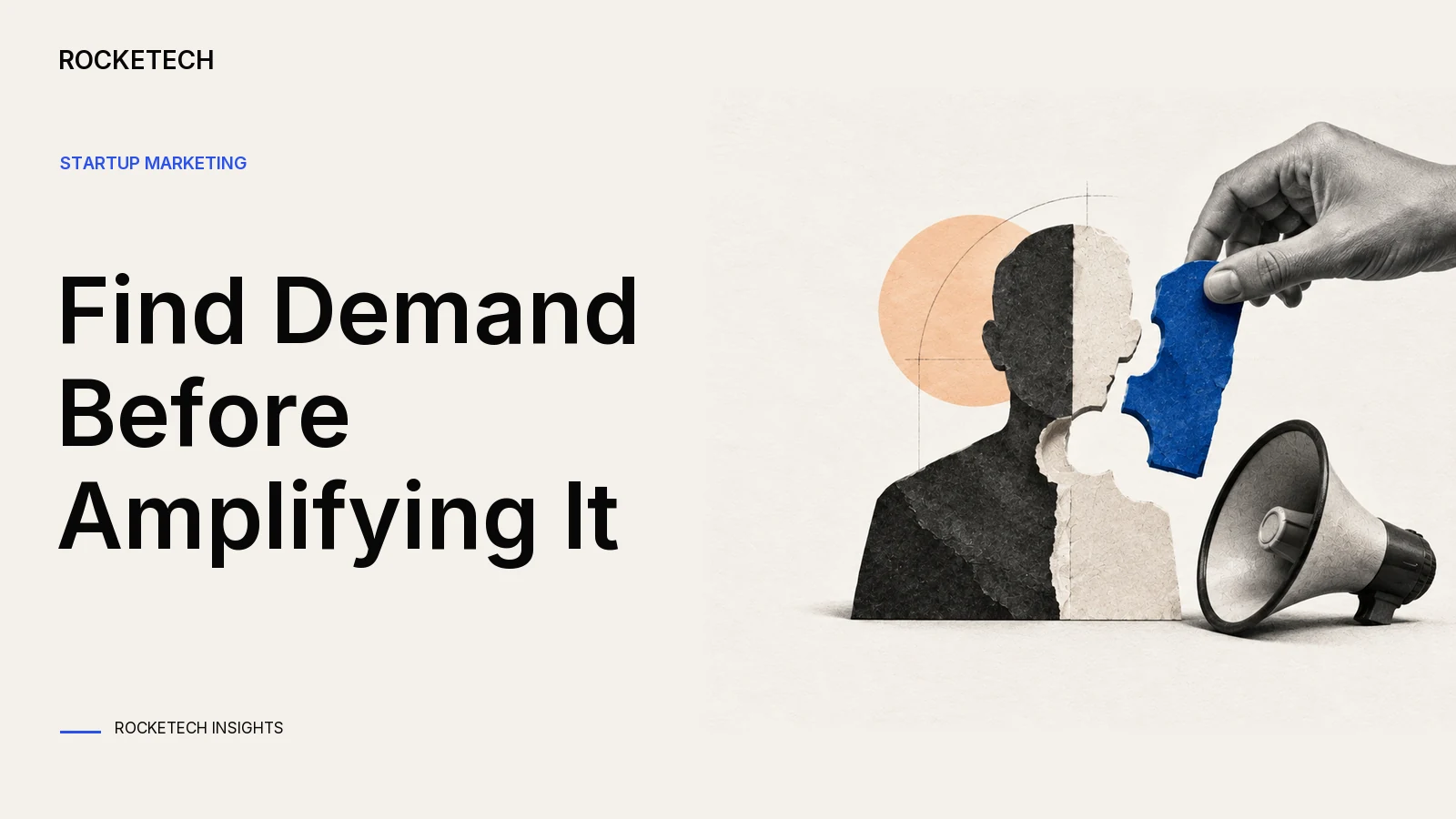
Many first-time founders hire a marketer early and expect growth to follow. But marketing scales something that already works. Before you know who buys, why they buy and what they’ll pay, there’s nothing to scale. A marketing team at that stage spends money on guesses.
This guide covers what a marketing team costs in 2026, why it fails before product-market fit, what the founder should do at each stage instead, and the signs it’s time for your first marketing hire.
What a marketing team costs in 2026
Marketing people are well paid. In May 2025 the median US marketing manager earned $166,790 a year, according to the US Bureau of Labor Statistics Occupational Outlook Handbook. The median market research analyst earned $78,760.
That’s wages only. Wages are about 70% of what US private employers spend on a worker; the other 30% is benefits, according to the BLS compensation survey for June 2026. Add tools and ad spend on top.
Compare that with the product itself. A typical MVP with us costs $5,000-15,000. One marketing manager’s yearly pay is many times that, spent before you know whether the product works.
Why a marketing team fails before product-market fit
There’s no customer yet
Good marketers find more of the people who already buy. When nobody buys yet, they have to guess who the audience is. In CB Insights’ March 2026 study of startups that shut down since 2023, 43% of those with a known reason cited poor product-market fit. Marketing can’t fix a product people don’t need.
The plan will change
An early product changes as you learn. Features get cut, the customer group shifts and sometimes the whole direction moves. A brand, a slogan and a channel plan built for version one may not fit version three. If you pivot, most of that work goes in the bin.
Nobody knows what a customer costs to win
In the same study, 19% of the startups cited unit economics that didn’t work. Until you’ve won customers yourself, the cost to win one is a guess, and a team will spend money against that guess.
A startup has no playbook
A new salon or pizzeria has a playbook: known customers, known channels and a revenue forecast you can trust. A startup is searching for those answers. It needs experiments, not a campaign calendar.
What to do at each stage instead
Stage
Who does it
What it looks like
What it costs
Idea
The founder
Problem interviews; a list of people who have the problem
Your time
Prototype
The founder
Solution interviews, pre-orders, a simple landing page
A domain and a page builder
First version live
The founder, maybe one freelancer
Test one channel at a time and measure what a customer costs to win
A small test budget you set in advance
Repeatable sales
A first marketing hire
Put more into the channel that works
A planned budget
Growth
A marketing team
Several channels, brand, content
Paid from revenue or a funding round
Who does marketing at each stage of a startup
Steve Blank, who created customer development, puts it in the same order: create demand at scale only after you’ve shown people will pay. Our guide to customer development explains the four steps.
The founder sells first
At the start, nobody can do this better than the founder. You know the problem, you can change the product the same week, and you hear every objection first-hand. Sell the first customers yourself, one conversation at a time. Write down why each one bought and where they found you. Those notes become your first marketing plan.
Marketing work does have a place once something is live and people pay. The founder of GhostMinutes, an AI meeting notes app, planned it that way: get a paid product in front of users quickly, then find out which audience and price work. We shipped the iOS app in 2 weeks and the web app a week later.
After launch, the founder’s marketing team tested features and ways to charge. The live product now has landing pages for each audience (sales teams, consultants, people who transcribe video), a quiz that suggests a plan, four plans and minute packs. It reached $1,500 in monthly recurring revenue. The marketing work tested a real product with real buyers, instead of guessing in advance.
Five signs it’s time for your first marketing hire
You can name the customer group that buys most often, and say why in their words.
At least one channel brings customers at a cost you’ve measured, not guessed.
Customers stay. People who start using the product keep using it.
What a customer brings in over their lifetime is clearly more than the cost to win them.
The founder’s time is now the bottleneck for sales.
When most of these are true, hire one person who runs experiments across channels, not a brand team. Add specialists once a channel is clearly working.
How we would estimate this
The cost to win a customer decides when your build pays for itself. Here’s an example run of our estimate’s math with sample inputs for a local services marketplace with a client app, a provider dashboard and online payments. The inputs are assumptions, not data: $14 a month in revenue per paying customer, an 80% margin, 8 months a customer pays, $30 to win a customer and 150 new customers a month.
With those guesses, the build comes to $8,100 to $16,700 over 4 weeks. Each customer brings $11 a month in profit, $88 over their lifetime and $58 after the cost of winning them. So 214 customers pay for the build ($12,400). The first month that earns more than it spends is month 3, and the build is paid back in month 7. If winning a customer really costs more than $30, all of that moves. That’s why you test channels yourself before you pay a team to scale one.
Our project estimate turns your brief into user stories. You confirm what’s in scope, and every hour in the budget traces back to a story you kept. We check the hours the model suggests against what our team actually books on finished projects, then multiply by our published rate of $39-55 an hour. For market size, it suggests customer groups and gives each one a TAM, SAM and SOM with a note on what the number covers. Treat them as hypotheses to test, not verified demand. You can get a free estimate of your build and change any starting number to see the payback month move.
What we would do
Hold off on hiring marketers until you have paying customers.
Spend the first weeks on problem interviews and a list of people who have the problem.
Build the smallest version that tests whether people will pay. Our MVP development typically costs $5,000-15,000 and takes 2-4 weeks.
Sell the first customers yourself and write down why each one bought.
Test one channel at a time with a fixed small budget, and measure what a customer costs to win.
Hire your first marketer when most of the five signs are true.
Do you have an idea? Let’s bring it to life together.
FAQ
Do I need a marketing team for my early-stage startup?
Usually not before product-market fit. Until you know who buys and why, a team spends money on guesses. The founder should sell the first customers and run small channel tests.
How much should an early-stage startup spend on marketing?
Before launch, mostly time: interviews, a landing page and pre-orders. After launch, set a small fixed budget for one channel test at a time, and measure the cost to win a customer before you spend more.
When should a startup hire its first marketer?
When you can name the customer group that buys and why, at least one channel brings customers at a measured cost, customers stay, and the founder’s time has become the limit on sales.
What marketing can a founder do alone?
Customer interviews, direct outreach to people with the problem, a simple landing page with a sign-up or pre-order, and small tests of one channel at a time. Every one of them also teaches you about the product.
Do I need a marketing plan before launch?
You need a short plan for learning, not a full campaign plan: who you’ll talk to, which channel you’ll test first and what result would make you stop. A detailed plan comes after you know what works.
The best of our blog, bi-weekly
Carefully curated content for resourceful Devs, CTOs, and PMs. No spam.